

The Wole Soyinka Centre for Investigative Journalism (WSCIJ) has expressed renewed concern over the shrinking civic space in Nigeria, warning that increasing restrictions on freedom of expression, peaceful assembly and access to information are undermining democratic governance.
The warning is contained in the Centre’s 2025 Journalism and Civic Space Status Report, titled “Silenced Voices, Shrinking Space: Civic Freedoms Under Pressure,” which was unveiled during the 18th Wole Soyinka Centre Media Lecture Series in Lagos.
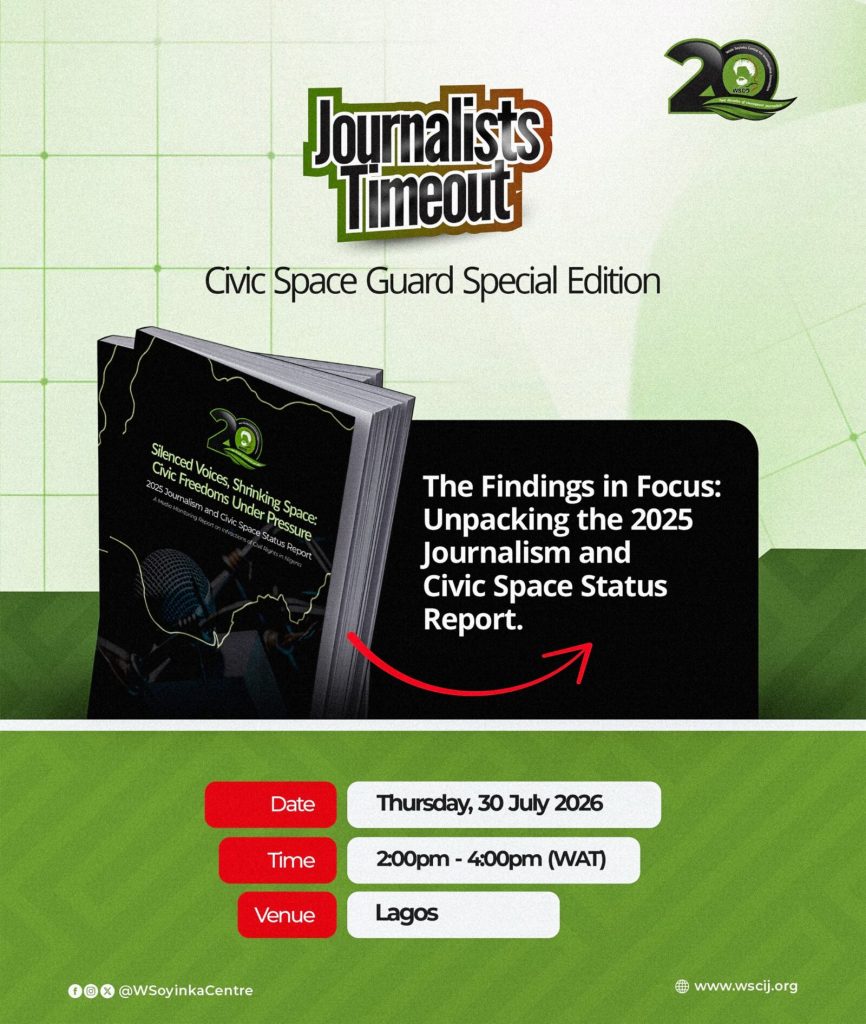
The report was further examined by veteran and emerging journalists during the Journalist Timeout programme on Thursday. As the fourth edition of WSCIJ’s annual civic space assessment, it presents an evidence-based review of developments between January and December 2025, highlighting what it describes as increasing institutional restrictions, systematic repression and heightened risks faced by journalists, civil society organisations and ordinary citizens.
According to the report, although Nigeria’s Constitution guarantees fundamental human rights, civic freedoms continue to face sustained pressure through administrative actions, institutional practices and intimidation.
WSCIJ documented 245 verified civic space violations drawn from 570 media reports published by 54 media organisations nationwide.
The cases involved alleged violations of freedom of expression, access to information, peaceful assembly and freedom of association.
The report revealed that law enforcement agencies were linked to 219 incidents, representing 89.4 per cent of all verified cases.
The Nigeria Police Force accounted for 118 incidents, equivalent to 54 per cent of the documented violations.
While journalists and media practitioners have traditionally been the primary victims of civic space restrictions, the Centre noted a significant rise in cases involving ordinary citizens.
According to the findings, 133 incidents, representing 54.3 per cent of all verified cases, affected members of the public, indicating that citizens participating in peaceful protests, public advocacy and democratic activities are increasingly becoming targets.
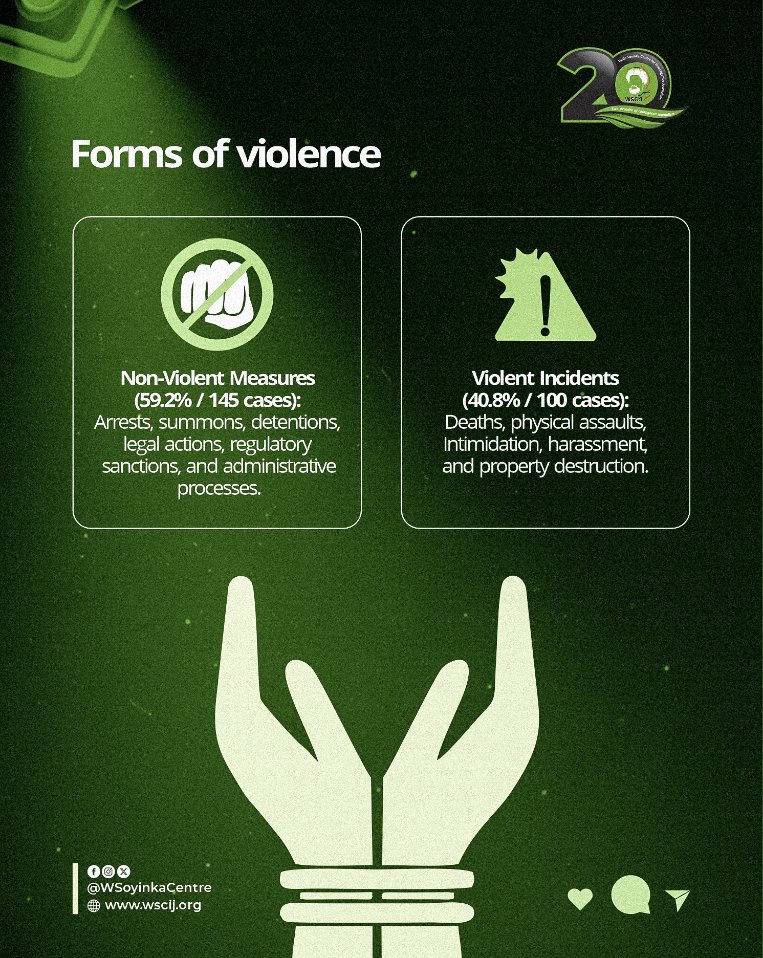
The report further showed that 100 incidents involved physical violence and intimidation, while the larger share—145 cases—consisted of non-violent administrative actions such as arbitrary arrests, prolonged detention, legal summons and regulatory sanctions.
It also pointed to the use of legislative provisions that, according to the Centre, could discourage public participation and free expression.
Geographically, Abuja recorded the highest number of documented incidents, followed closely by Lagos, a trend WSCIJ attributed to their roles as the nation’s political, economic and media hubs. However, the Centre cautioned that lower figures from other states should not be interpreted as fewer violations, noting that underreporting and the normalisation of restrictions may account for the differences.
WSCIJ stressed that safeguarding civic space is essential to sustaining democracy, insisting that citizens must be free to express their views, assemble peacefully and hold public institutions accountable without intimidation.
Based on its findings, the Centre urged regulatory bodies, security agencies and law enforcement authorities to strengthen institutional accountability, pursue legal reforms and ensure that responses to public gatherings comply with human rights standards.
It also called on the National Assembly to review laws considered vague or capable of criminalising legitimate online and offline expression. In addition, the report encouraged media organisations and civil society groups to strengthen civic space reporting, expand public awareness campaigns and reinforce physical and mental safety mechanisms for journalists and activists.
WSCIJ further appealed to international development partners to continue supporting civic monitoring initiatives and early-warning systems.
The Centre noted that the report forms part of its broader Civic Space Project, which seeks to advance social justice, human rights, democratic accountability and good governance through investigative journalism, capacity building and public engagement.