

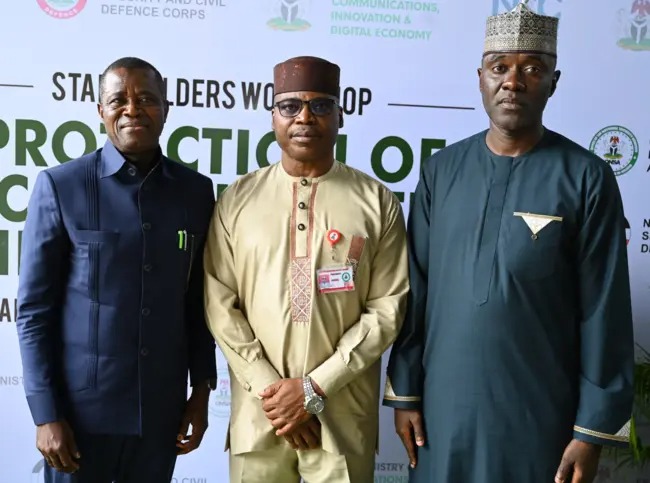
L – R: Rafiu Adeladan, Permanent Secretary, Federal Ministry of Works; Air Vice Marshal Effiom Ewa, Director, Directorate of Critical National Assets and Infrastructure Protection (DCNAIP), Office of the National Security Adviser (ONSA); Dr. Aminu Maida, Executive Vice Chairman/CEO, Nigerian Communications Commission (NCC); during the Stakeholders’ Workshop for the Protection of Fibre Optic Cables During Road Construction, held on 11 August 2026 at the National Counter Terrorism Centre, Office of the National Security Adviser, Abuja.
The Nigerian Communications Commission (NCC) has raised the alarm over the increasing damage to fibre-optic infrastructure during road construction and other civil works, revealing that more than 5,000 fibre-cut incidents were recorded across Nigeria in the first six months of 2026.
The NCC urged road construction companies, contractors, engineers, government agencies and other stakeholders to strengthen coordination and adopt preventive measures to protect fibre-optic cables during road construction, rehabilitation, excavation and related projects.
The Executive Vice Chairman and Chief Executive Officer of the NCC, Dr. Aminu Maida, made the call on Tuesday, August 11, 2026, at a stakeholders’ workshop on the protection of fibre-optic cables held at the National Counter-Terrorism Centre (NCTC), Office of the National Security Adviser, Abuja.
Maida stressed that Nigeria’s drive to expand physical infrastructure must not undermine the digital infrastructure connecting citizens to information, services, markets and economic opportunities.
According to him, communications infrastructure has become a critical national lifeline supporting banking, government services, education, healthcare, commerce, security and emergency communications.
He warned that damage to fibre infrastructure could disrupt essential services and impose significant costs on citizens and the wider economy.
«“To a machine operator on a construction site, it may appear to be one buried cable. To the nation, it can mean failed calls, stalled payments, interrupted services and missed opportunities,” Maida said.»
The NCC chief executive disclosed that over 5,000 fibre-cut incidents were recorded in the first six months of 2026, largely as a result of road construction, excavation and related civil works.
He also recalled that in February 2024, fibre cuts, including those caused by road construction, contributed to an almost network-wide disruption for one telecommunications operator, affecting millions of users for several hours and putting additional pressure on other networks.
Maida said the challenge should not be viewed as an issue of blame, noting that road contractors do not deliberately seek to disconnect communities, just as telecommunications operators do not intend to obstruct road construction.
Instead, he called for a dependable system of early coordination among road contractors, telecom operators, government agencies and other relevant stakeholders.
“Our central message is simple: Nigeria must build the roads that connect our communities while protecting the fibre networks that connect our economy. We need both forms of infrastructure, and we need them to work together,” he said.
Maida further disclosed that the Permanent Secretaries of the Federal Ministry of Works and the Federal Ministry of Communications, Innovation and Digital Economy had inaugurated a Standing Committee on the Protection of Fibre Optic Cables.
The committee is expected to develop practical coordination mechanisms for protecting fibre infrastructure before, during and after road construction works.
He added that the committee’s membership had recently been expanded to include representatives of the Office of the National Security Adviser (ONSA), reflecting the security implications of protecting telecommunications infrastructure, which has been designated as Critical National Information Infrastructure.
According to him, the designation means telecommunications infrastructure must be treated as national infrastructure and protected accordingly, with appropriate legal, regulatory and remedial consequences for damage.
The NCC EVC therefore urged telecommunications operators, contractors, government agencies, regulators and security agencies to play their respective roles in preventing fibre damage.
He emphasized that stronger collaboration and advance planning are essential to ensuring that road development does not come at the expense of Nigeria’s critical digital infrastructure.
L – R: Rafiu Adeladan, Permanent Secretary, Federal Ministry of Works; Air Vice Marshal Effiom Ewa, Director, Directorate of Critical National Assets and Infrastructure Protection (DCNAIP), Office of the National Security Adviser (ONSA); Dr. Aminu Maida, Executive Vice Chairman/CEO, Nigerian Communications Commission (NCC); during the Stakeholders’ Workshop for the Protection of Fibre Optic Cables During Road Construction, held on 11 August 2026 at the National Counter Terrorism Centre, Office of the National Security Adviser, Abuja.