

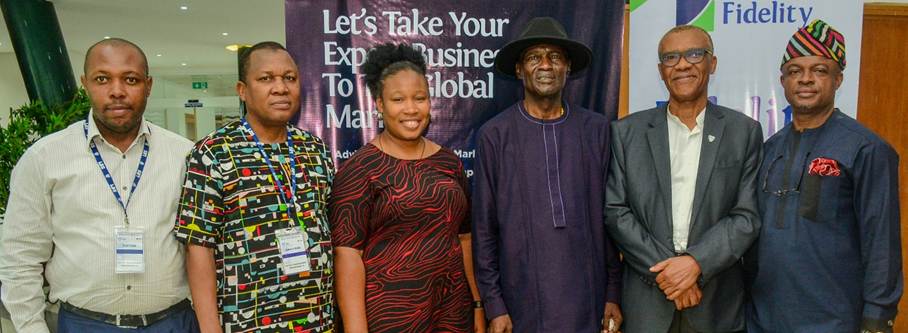
Photo caption:
L-R: Relationship Manager, Fidelity Bank Plc, Murtala Muhammed Road Branch, Kano, Victor Ngwu; Export Management Programme (EMP 19) participant, Abayomi Adewuyi; Facilitator, Gemma Ejiofor; Senior Fellow and Head, Department of Organisational Behaviour and Human Resources Mgt., Lagos Business School (LBS), Dr. Uche Attoh; Director, Export Management Programme, LBS, Prof. Frank Ojadi; and Team Lead, Export & Agriculture, Fidelity Bank Plc, Emmanuel Nwalor, during the closing ceremony of the 19th edition of the Fidelity Bank Export Management Programme (EMP 19) held recently at Lagos Business School, Lagos.
Fidelity Bank Plc has reinforced its commitment to Nigeria’s economic diversification drive by strengthening the capacity of exporters through the 19th edition of its Export Management Programme (EMP 19), held recently at the Lagos Business School (LBS), Ajah, Lagos.
Organised in partnership with Lagos Business School and the Nigerian Export Promotion Council (NEPC), the intensive export management workshop brought together entrepreneurs, professionals, regulators and aspiring exporters for practical training aimed at equipping them with the skills, knowledge and networks needed to compete effectively in global markets.
Speaking at the closing ceremony, Fidelity Bank’s Divisional Head, Export and Agriculture, Isaiah Ndukwe, said the bank remains committed to helping Nigerian businesses take full advantage of opportunities created by the African Continental Free Trade Area (AfCFTA) while expanding the nation’s non-oil export sector.
According to him, capacity development remains a key driver of Nigeria’s export potential, noting that the Export Management Programme provides businesses with practical expertise, market intelligence and strategic insights required to thrive in regional and international markets.
He added that as AfCFTA opens new trade opportunities across the continent, Fidelity Bank is determined to ensure Nigerian exporters are well-positioned to benefit from the agreement and contribute significantly to the country’s economic diversification efforts.
Ndukwe also reaffirmed the bank’s commitment to supporting exporters with tailored financial solutions, advisory services and strategic partnerships to help them expand beyond Nigeria’s borders.
Also speaking, the Director of the Export Management Programme at Lagos Business School, Professor Frank Ojadi, stressed the importance of continuous learning as the global export landscape continues to evolve.
He explained that changing trade policies, improved business processes and growing interest in export activities make regular capacity building essential for businesses seeking to remain competitive.
Professor Ojadi noted that this year’s programme placed strong emphasis on AfCFTA, exposing participants to both the theoretical and practical aspects of leveraging the continental trade agreement for business expansion.
According to him, many businesses are still exploring how to maximise the benefits of AfCFTA, and the programme provided participants with practical knowledge to identify and exploit opportunities across African markets and beyond.
In his presentation, Dr. Uche Attoh, Senior Fellow and Head of the Department of Organisational Behaviour and Human Resources Management at Lagos Business School, underscored the importance of negotiation and dispute resolution in international trade.
He said effective negotiation enables businesses to secure profitable deals, while arbitration provides mechanisms for resolving disputes, adding that these principles are applicable across business environments globally.
Participants described the programme as highly impactful. Obinna Oforum, an Assistant Director at the Nigerian Shippers’ Council, said the training strengthened his determination to become an “export champion.”
Similarly, Chief Superintendent of Customs, Orji Samuel, commended Fidelity Bank and Lagos Business School for subsidising the programme and providing participants with practical learning opportunities, noting that the knowledge acquired would help them overcome export challenges and unlock new business opportunities.
The Export Management Programme is Fidelity Bank’s flagship capacity-building initiative designed to develop export-ready businesses and professionals capable of driving Nigeria’s non-oil export growth. Through strategic collaborations and targeted interventions, the bank continues to support businesses, facilitate trade and promote sustainable economic development.
Fidelity Bank Plc serves more than 10 million customers through its digital banking platforms, 255 business offices across Nigeria and its United Kingdom subsidiary, FidBank UK Limited. The bank has received several local and international recognitions, including the 2025 Development Bank of Nigeria Innovation Award for MSME Support, Best Retail and SME Bank, Best Bank for Export & Trade Finance, Most Innovative Bank of the Year at the 2025 BAFI Awards, Nigeria’s Best Private Bank at the 2025 Euromoney Awards, as well as honours from Nairametrics, NewsDirect, Citi Group and Global Brands Magazine.