

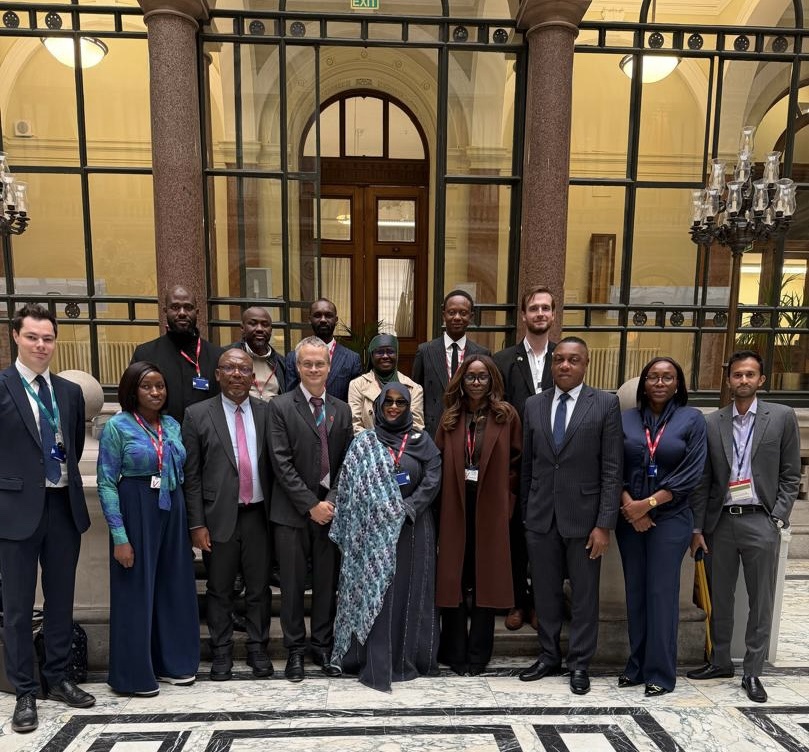
The United Kingdom and Nigeria have reinforced their collaboration to combat illicit financial activities following high-level engagements in the UK focused on financial intelligence, information sharing and cross-border cooperation.
Newsconnect online reports that the partnership, which seeks to strengthen efforts against money laundering, fraud and terrorism financing, also places emphasis on public-private sector collaboration in identifying and disrupting financial crimes.
The Nigerian delegation was led by the Chief Executive Officer of the Nigerian Financial Intelligence Unit (NFIU), Hafsat Bakari, and included representatives of the Central Bank of Nigeria (CBN), Nigeria Data Protection Commission (NDPC), Nigerian Communications Commission (NCC), as well as stakeholders in the banking and telecommunications industries.
A major highlight of the engagements was a meeting with the United Kingdom’s Joint Money Laundering Intelligence Taskforce (JMLIT), an innovative public-private partnership that brings together law enforcement agencies, regulators and private-sector organisations to identify and tackle financial crime threats.
The delegation also held working sessions with JMLIT and UK Finance, providing opportunities for both countries to exchange knowledge and experiences on financial intelligence, information sharing and joint strategies for addressing illicit financial activities.
The discussions further advanced Nigeria’s plans to establish the Joint Financial Intelligence Cooperation (JFIC), a Nigerian-led public-private partnership designed to improve cooperation between government institutions and private-sector organisations.
Built around trust, effective governance and technology-driven collaboration, the initiative is expected to strengthen the country’s ability to detect and respond to money laundering, fraud, terrorism financing and other forms of illicit financial activities.
During the visit, the Nigerian delegation also engaged senior officials of the UK’s National Crime Agency (NCA), UK Financial Intelligence Unit (UKFIU), HM Revenue and Customs (HMRC), Foreign, Commonwealth and Development Office (FCDO), and HM Treasury.
Key issues discussed included operational cooperation, the UK’s Financial Action Task Force (FATF) Presidency, trade-based money laundering, emerging financial crime threats and opportunities for deeper international collaboration.
Speaking on the engagements, Chris Chalmers, Deputy Director of the Illicit Finance and Anti-Corruption Department at the FCDO, described the UK-Nigeria relationship as a longstanding partnership in tackling illicit financial flows.
He noted that illicit finance threatens the economies of both countries and provides resources for criminal and other malicious transnational networks.
According to him, the recent engagements provided an opportunity to strengthen cooperation on shared threats, international standards and public-private partnerships.
Chalmers reaffirmed the FCDO’s commitment to supporting Nigeria in operationalising the Joint Financial Intelligence Cooperation initiative.
In her remarks, NFIU Chief Executive Officer, Hafsat Bakari, stressed that the increasingly interconnected and international nature of illicit financial networks makes cooperation between countries and institutions essential.
She explained that Nigeria is strengthening its financial intelligence framework through initiatives such as JFIC, which will provide a platform for public institutions and private-sector partners to work more effectively together.
Bakari added that the partnership with the UK offers valuable opportunities to share expertise and develop practical solutions that align with Nigeria’s priorities, strengthen its financial system and ensure intelligence translates into measurable results.
Also speaking, Marc Brown, NECC Fraud Threat Lead at the NCA, said the partnership between the National Economic Crime Centre (NECC) and NFIU reflects both countries’ commitment to protecting economic prosperity through a stronger collective response to financial crime.
He assured that the NCA would continue supporting Nigeria’s development of the JFIC initiative, particularly in improving intelligence sharing, operational efficiency and the capacity to prevent and disrupt activities capable of undermining both economies.
The UK and Nigeria reaffirmed their commitment to expanding cooperation against illicit financial activities, strengthening intelligence exchange and protecting the integrity of their financial systems through effective public-private partnerships.