

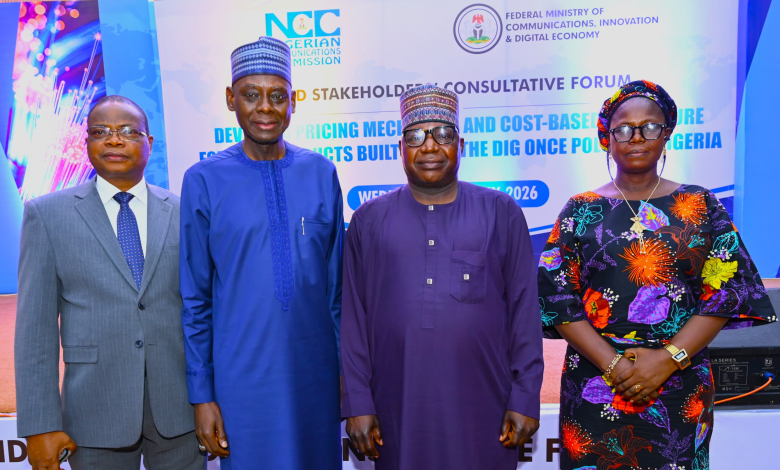
NCC is advancing plans for a transparent, cost-based framework for sharing broadband infrastructure built under Nigeria’s Dig Once Policy, while reaffirming its commitment to the initiative aimed at expanding nationwide connectivity.
The commitment was reiterated at the Second Stakeholders’ Consultative Forum on Developing a Pricing Mechanism and Cost-Based Structure for Sharing Ducts Constructed under the Dig Once Policy, held on Wednesday at the NCC Annex Office in Mbora, Abuja.
The forum convened representatives of federal and state agencies, telecom operators, infrastructure companies, industry associations, development partners and other stakeholders to review interim study findings and contribute to the design of an equitable and transparent system for sharing underground duct infrastructure.
Speaking at the event, the NCC’s Director of Policy, Competition and Economic Analysis, Ayuba Shuaibu, said the exercise reflects the Commission’s dedication to an open and inclusive regulatory process that takes into account the interests of infrastructure owners, network operators, public institutions and consumers.
He explained that the proposed framework is expected to promote infrastructure sharing, optimise asset use, lower broadband deployment costs and accelerate the spread of telecommunications infrastructure nationwide. The study seeks to establish a fair pricing mechanism for ducts installed during road construction and rehabilitation projects under the Dig Once Policy, thereby enabling future fibre deployments without repeated road excavation.
Shuaibu added that stakeholders’ recommendations would be incorporated into the final report to ensure the framework is practical, commercially viable and aligned with industry realities.
In his keynote address, Olugbenga Olabiyi, Managing Director of Dimension Data Limited, noted that passive infrastructure such as ducts, conduits and manholes represents one of the most expensive elements of broadband deployment globally.
He described infrastructure sharing as a proven means of reducing costs, improving efficiency and speeding up broadband expansion.
Olabiyi said Nigeria’s Dig Once Policy offers a significant opportunity to coordinate infrastructure deployment, minimise unnecessary road works and enhance broadband access. He stressed that predictable, transparent and equitable access rules are essential, warning that inconsistent pricing and unclear conditions could discourage investment and undermine the benefits of infrastructure sharing.
Participants at the forum examined the proposed pricing methodology and implementation issues, with discussions centred on achieving efficient infrastructure deployment while balancing the interests of infrastructure providers, access seekers and consumers. The consultation forms part of the NCC’s broader efforts to foster broadband growth, encourage infrastructure sharing and drive Nigeria’s digital transformation.