

By Abayomi Elias

An independent election observer, Ezenwa Nwagwu, has rated the Independent National Electoral Commission (INEC) 80 percent for its conduct of the February 21 Federal Capital Territory (FCT) Area Council elections and the bye-elections in Rivers and Kano States, insisting that the exercise showed significant improvement despite noticeable challenges.
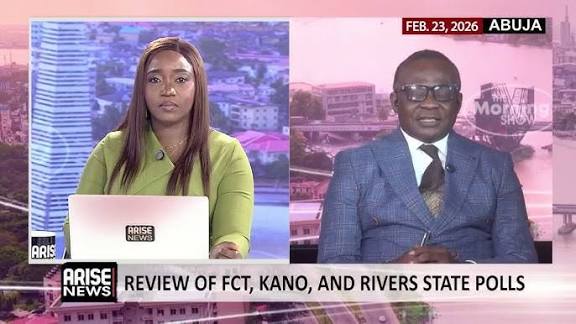
Nwagwu, who is the Executive Director of the Peering Advocacy and Advancement Centre in Africa (PAACA), gave the assessment during an appearance on The Morning Show on Arise News.
According to him, while INEC faced logistical setbacks and communication gaps—particularly regarding the splitting and relocation of polling units—the overall performance of the electoral body marked progress.
“Election is a process, not an event,” Nwagwu stressed, adding that improvements should be measured holistically rather than judged solely by isolated shortcomings.
His 80 percent rating, however, sparked debate on the programme. Co-anchor Rufai Oseni questioned the basis of such a score, citing declining voter turnout as a sign of democratic fatigue.
Oseni pointed out that voter turnout dropped from 35 percent in 2019 to between 25 and 29 percent in 2023, and further down to about 15 percent in the recent elections.
“Isn’t that an indication of failure? Doesn’t it show that people have checked out?” he asked.
But Nwagwu disagreed, arguing that participation in an election goes beyond casting ballots on election day. He revealed that about 95 percent of registered voters collected their Permanent Voter Cards (PVCs), describing it as a strong indicator of public interest in the electoral process.
“If people had truly lost interest, they wouldn’t have collected their PVCs,” he said, noting that both ruling and opposition parties had equal opportunities to mobilise supporters.
He maintained that abstaining from voting does not invalidate the outcome. “Whether turnout is 35 percent or 15 percent, someone will still emerge as chairman in AMAC, Kuje, or Gwagwalada,” he stated, warning that citizens who fail to vote may end up with leaders they do not prefer.
Addressing concerns about reported violence in some polling units, Nwagwu urged Nigerians to analyse elections based on scale rather than sensational headlines.
“If there are 500 polling units in the FCT and violence occurs in three or four, as bad as that is, it does not invalidate the entire exercise,” he explained. “It would not be fair to place a complete black tag on the whole process because of isolated infractions.”
While acknowledging that logistics remain a recurring weakness for INEC, Nwagwu called for early funding and timely engagement of vendors to avoid last-minute emergencies that could create room for discretion and, potentially, corruption.
“Once you create emergencies, discretion comes into play, and where there is discretion, corruption can thrive,” he warned.
He also noted that election security involves multiple stakeholders, suggesting that relatively peaceful conduct in most areas deserved some credit.
On the professionalism of INEC staff, Nwagwu said field officials performed creditably, with the major challenge being delays caused by voters struggling to locate their designated polling units.
In his final analysis, he urged greater institutional support for INEC to strengthen logistics, security coordination, and communication systems, insisting that sustainable improvements—not blanket condemnation—are key to deepening Nigeria’s democracy.